You have filled OMR sheets in previous years. Now NEET 2027 will run on a computer, and one question keeps coming back: “What do I change in my practice now?” NEET 2027 CBT mode changes how you read a question, mark an answer and review your paper, but it does not change your syllabus, your NCERT or your three subjects.
Good NEET 2027 CBT practice means keeping your study on paper and moving your testing to the screen, step by step. You will see what changes on the screen, seven habits to change, a phase-wise plan and the right way to take a CBT mock. Every NEET 2027 aspirant is making this switch for the first time, so what decides your result is how many screen tests you take before the exam, not where you start.
NEET 2027 CBT Mode: Quick Overview
NEET 2027 will run as a Computer-Based Test at NTA exam centres, and the subjects you study stay the same. The table shows what you can plan around today. You can also read the expected NEET 2027 exam pattern in detail.
Why the change? NEET UG 2026 was cancelled after a paper leak, and on 15 May 2026 Union Education Minister Dharmendra Pradhan announced that NEET would move to CBT from 2027, naming the OMR-based format as the root cause. The 2026 re-exam stayed on paper, so 2027 is the first CBT year for NEET.
| Particular | Details | Status |
| Mode | Computer-Based Test (CBT) at NTA exam centres | Confirmed |
| Subjects | Physics, Chemistry, Biology (Botany and Zoology) | No change announced |
| Questions, marks, time | 180 questions, 720 marks, 3 hours, as in the NEET 2026 Information Bulletin | Expected |
| Marking scheme | +4 for a correct answer, -1 for a wrong answer, as in the same bulletin | Expected |
| Shifts and normalisation | Not yet announced | Awaited |
| Exam date and official NEET CBT mock | Not yet announced | Awaited |
What Changes from OMR to CBT in NEET 2027?
Only the medium changes: you read on a screen, click to answer and do all your working on a rough sheet. The questions still come from the same chapters.
| What you do | OMR mode (till 2026) | CBT mode (2027) |
| Read the question | You read a printed booklet | You read a screen, one question at a time |
| Mark the answer | You darken a bubble with a pen | You click an option and save it |
| Change an answer | You cannot change a darkened bubble | You can change it any time before you submit |
| Mark the paper | You underline and circle on the booklet | You cannot mark the screen, so you use the rough sheet |
| Track attempts and time | You flip pages and look at the wall clock | The palette and the on-screen timer show both |
The paper still asks MCQs with four options, so you need a new testing habit, not a new study plan.
How Does the NEET CBT Screen Work?
The screen shows one question at a time, with a timer on top and a colour-coded question palette on the side. The screenshot below is from NTA’s computer-based mock test. You answer with Save & Next, save and flag in one step with Save & Mark for Review, flag a question without answering with Mark for Review & Next, and remove an answer with Clear. The one rule to remember is that the computer counts an answer only after you save it, so clicking an option alone is not enough.
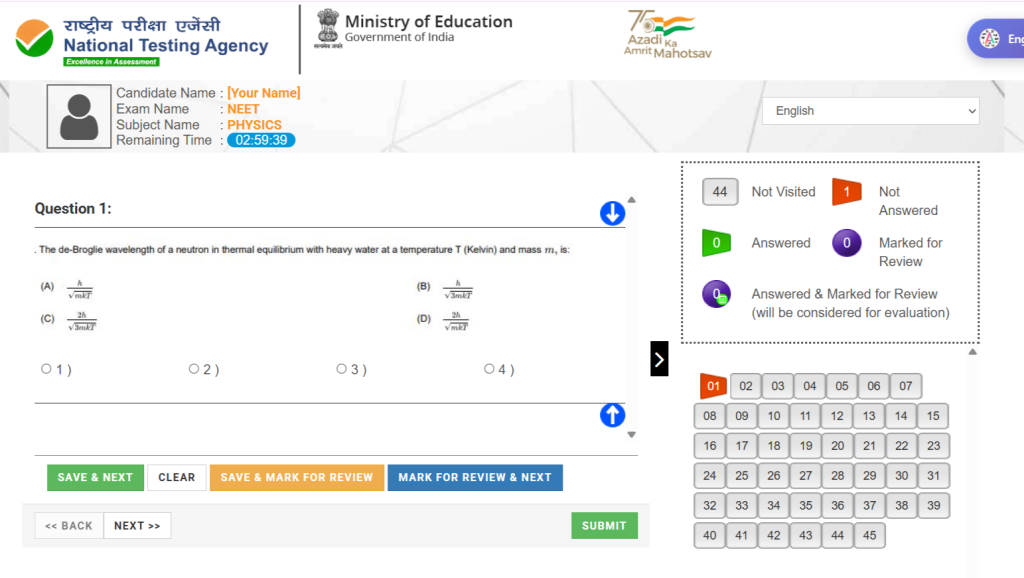
NTA’s computer-based test screen with its eight parts numbered. Source: NTA mock test interface.
| Palette status | What it means | Does NTA count it? |
| Not Visited | You have not opened the question | No |
| Not Answered | You opened it but saved no answer | No |
| Answered | You saved an answer | Yes |
| Marked for Review | You flagged it without an answer | No |
| Answered and Marked for Review | You saved an answer and flagged it | Yes, as NTA’s mock test screen states |
Students mix up the last two rows most often, so learn them now. NTA’s own mock test screen says this status “will be considered for evaluation”, and the NEET 2027 bulletin will confirm it for the real exam.
Which 7 Practice Habits Should You Change?
You should change seven habits: how you read, do rough work, mark answers, flag questions, change answers, move between subjects and watch the time. Each row gives the new way on screen and one drill for this week.
| Habit | New way on screen | Drill this week |
| 1. Reading | You note keywords on the rough sheet | Write the given values and the “NOT” word before you solve |
| 2. Rough work | Your eyes move between screen and sheet | Write the question number before every calculation |
| 3. Marking | You click and save each answer at once | Check the selected option before Save & Next |
| 4. Flagging doubts | You use Mark for Review | Fix a limit on flags per subject and clear them in one slot |
| 5. Changing answers | You can change any answer | Change only for a clear error, never on a feeling |
| 6. Moving around | You jump by question number on the palette | Jump by question number five times in your next test |
| 7. Watching time | A countdown timer stays on screen | Fix three checkpoints and look only at those |
What Feels Different in Physics, Chemistry and Biology?
Physics and Chemistry push more work to your rough sheet, while Biology asks you to read long statements on the screen.
| Subject | What feels different on screen | What to practise |
| Physics | Multi-step calculations move fully to the rough sheet | Copy values from screen to paper with care, then solve |
| Chemistry | You read structures and long numericals from the screen | Redraw only the part you need for the answer |
| Biology | Statement and match-the-column questions need scrolling | Read the full question before you look at the options |
Practise each subject’s screen habit in its own chapter tests first, and then combine all three in a full mock.
How Should You Shift from OMR to CBT, Phase by Phase?
Shift in four phases: start with one screen test a week and reach full CBT mocks in the last phase before the exam. This plan uses phases, and you can fit them to your calendar once the exam date comes.
| Phase | Tests on screen | What you do |
| 1: Get familiar | Mostly OMR, one screen test a week | Learn the screen on a practice test and take chapter tests on a computer |
| 2: Mix both | About half and half | Take part tests on screen and one full CBT mock every two weeks |
| 3: Screen first | Mostly screen | Take a full CBT mock every week and analyse it from the screen report |
| 4: Exam mode | All full tests on screen | Take full mocks in the real exam slot with rough sheets only |
Treat this split as a starting structure and adjust it with your teachers. Do not drop OMR practice overnight, because a sudden switch hurts your scores and your confidence together. If you are a dropper, your OMR habit is older, so begin from Phase 2 and stay longer in Phase 3.
A Sample Week in Phase 3
• Monday to Wednesday: One subject test on screen each day: Physics, Chemistry and Biology in turn
• Thursday and Friday: Error correction from those tests, on paper
• Weekend: One full CBT mock in one sitting, and the analysis the next morning
How Do You Take a NEET CBT Mock Test the Right Way?
Take every CBT mock on a desktop or laptop with a mouse, in one sitting, with only rough sheets on your table, because a mock helps you only when it copies the exam hall.
1. Use a computer with a mouse, not a phone, and keep the screen at eye level.
2. Keep only plain rough sheets and a pen with you.
3. Finish the full test in one sitting, in the real exam slot once NTA announces it.
4. Attempt the paper in three rounds, as the table below shows.
5. Analyse the test the same day: wrong answers, unsaved answers and time per subject.
An example time split for 3 hours:
| Round | What you attempt | Example time |
| Round 1 | Every question you can solve directly | About 120 minutes |
| Round 2 | Flagged questions that need a calculation or a second reading | About 45 minutes |
| Round 3 | Final palette check for unsaved and unvisited questions | About 15 minutes |
Treat this as an example rather than a fixed rule: check it with your teachers, try it in your first three mocks and then move minutes between Round 1 and Round 2 as your own speed shows. In OMR mode you kept the last minutes for bubbling, and those minutes now go to Round 3. Three hours on a screen can also tire your eyes in a way a booklet does not, so build screen time step by step through the four phases, keep the monitor about an arm’s length away, and rest your eyes on the rough sheet for a moment between questions.
8 Things to Check Before Your First CBT Mock
1. The computer, the mouse and the internet connection work.
2. The screen sits at eye level on a table.
3. Four or five plain rough sheets and two pens are on the table.
4. Your phone is switched off and out of reach.
5. You have three free hours with no break.
6. You know the five palette statuses and which ones NTA counts.
7. You have fixed your three timer checkpoints.
8. You have kept 30 minutes for analysis after the test.
For practice tests, check NTA’s National Test Abhyas app first, and then use the computer-based tests in your own test series. You can also read how to increase your marks in NEET mock tests.
Which Mistakes Do Students Make in Their First CBT Mocks?
Most first-mock mistakes come from the new medium, and you can fix each one in a week or two.
| Mistake | Why it hurts | Fix |
| Selecting but not saving | The computer does not count that answer | Press Save & Next after every answer |
| Leaving flags unchecked | A flagged question with no saved answer earns nothing | Clear every flag in Round 2 |
| Solving in your head | Calculation errors rise without written steps | Write every step with its question number |
| Copying a value wrongly from the screen | A correct method still gives a wrong answer | Read each value twice before you write it on the rough sheet |
| Changing answers on a feeling | A correct answer can turn into a wrong one | Change an answer only when you find a clear error |
| Watching the timer all the time | Your focus moves away from the question | Look at the timer only at your three checkpoints |
No Computer at Home? How Can You Practise?
You can still practise well with a shared computer once a week for full mocks and your phone for small quizzes. You do not need to own a laptop; regular access to one for a few hours a week is enough.
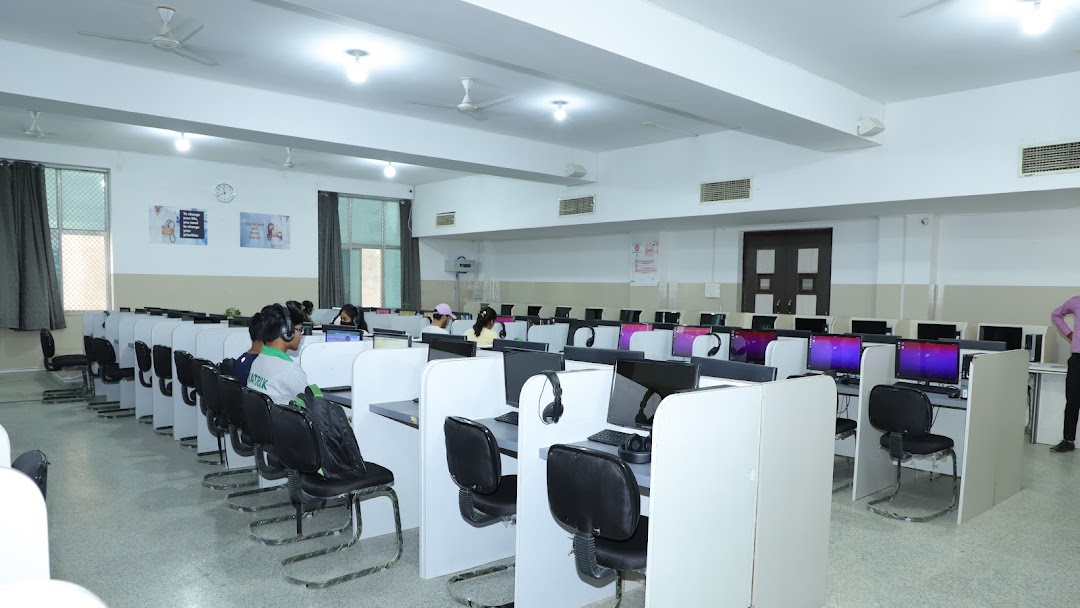
• The CBT tests and computer facilities at your coaching institute or school
• A relative’s or friend’s laptop for three hours a week
• A cyber cafe for one full mock every week
Your phone works for chapter quizzes, but it does not train your mouse hand. You also do not need typing speed or a computer course, because an MCQ exam asks only for basic mouse use.
Will NEET 2027 Have Multiple Shifts and Normalisation?
NTA has not announced the number of shifts or any normalisation method for NEET 2027 yet, and only the bulletin on nta.ac.in can confirm them. If NTA uses shifts, different shifts get different papers, and NTA would then adjust the scores to make them comparable. You cannot choose your shift, so prepare for the paper and not for the shift.
What Changes on Exam Day at a CBT Centre?
You will sit at an allotted computer in place of a desk with a booklet, and you will fill no OMR sheet. The NEET 2027 bulletin will give the final rules on login, rough sheets and technical problems. In NTA’s current CBT exams, you do all rough work on sheets from the centre and hand them back before you leave. Raise your hand at once if your computer or mouse stops working. For dress code and reporting time, follow your admit card and the NEET exam day guidelines.
What Should Parents Know?
Your child needs a few hours of computer access every week for mocks, and no new device for study. The first few CBT mock scores may dip while the habit forms, and that dip comes from the new medium rather than weaker preparation, so judge the trend across four or five mocks and not a single score. You can help most by arranging one fixed three-hour slot each week on a shared, school or institute computer, and by keeping the room quiet during that slot.
Further Reading
Matrix NEET Division, Sikar, runs CBT mock tests for its NEET 2027 students. For more, read how to prepare for NEET 2027 in Sikar and the Matrix guide to NEET 2027 CBT mode.
Conclusion
You started with one worry: two years of OMR practice and an exam that now runs on a screen. In NEET 2027 CBT mode, only your testing habit changes. Change the seven habits, shift your tests to the screen in four phases and take every mock like the real exam. Expect your first few screen tests to feel slow, and track two numbers in each one, unsaved answers and minutes per subject, until both settle. Follow only NTA for the final pattern, and take one chapter test on a computer this week with a rough sheet next to you.
FAQs
NEET 2027 will run in online CBT mode at NTA exam centres. The Education Minister announced this on 15 May 2026. You will not take the exam from home.
In NTA’s current CBT exams, NTA counts a question that you answered and marked for review. NTA does not count a question that you only marked. Confirm this from the NEET 2027 instructions.
No, you need only basic mouse use to click, save and move between questions. You do not type anything in an MCQ exam, and a few screen tests build this skill.
Nobody can say that honestly, because the questions come from the same syllabus and only the medium is new. Your first few screen tests may feel slower, and regular CBT practice removes that.
A CBT centre gives you sheets for rough work, because you cannot write on the screen. The NEET 2027 bulletin will confirm the exact rule, including extra sheets.