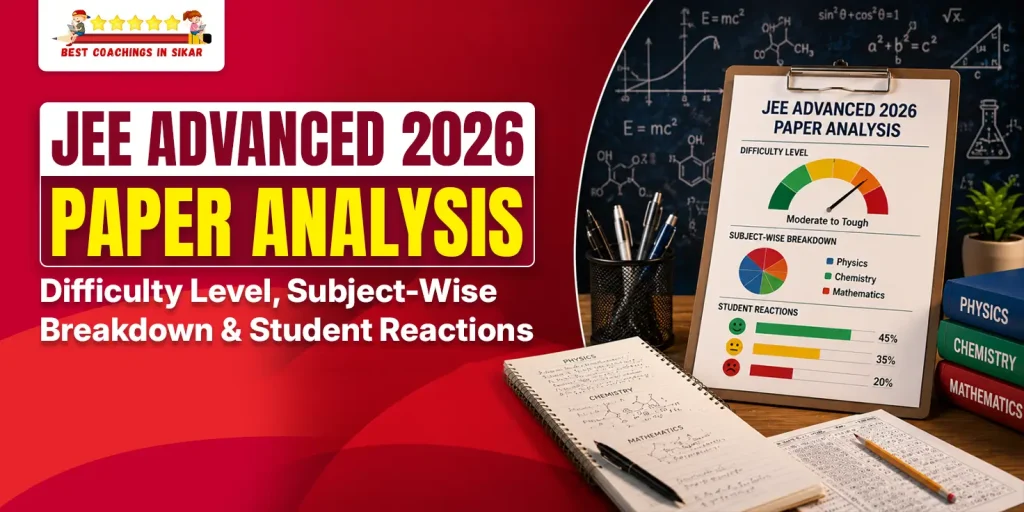
The JEE Advanced 2026 examination was successfully conducted on 17th May 2026 by the Indian Institute of Technology Roorkee. As expected, the exam once again tested students on conceptual clarity, analytical thinking, accuracy, and time management skills. Around 1.9 lakh qualified candidates appeared for the examination, competing for nearly 18,000 seats across various IITs in India.
Now that both Paper 1 and Paper 2 are over, students across the country are eagerly searching for the complete paper analysis, difficulty level, expected cut-off, memory-based questions, and answer key solutions. To help JEE aspirants and parents, the expert faculty team of various JEE coaching institutes has prepared a detailed and realistic JEE Advanced 2026 Paper Analysis based on direct student reactions and expert review. In this article, you’ll find the complete JEE Advanced 2026 Paper Analysis, including the overall difficulty level, Paper 1 and Paper 2 review, subject-wise analysis, good attempts, expected cutoff, marks vs rank, student reactions, and memory-based question papers prepared by experts.
JEE Advanced 2026 Paper 1 Overall Difficulty Analysis
Now that the JEE Advanced 2026 Paper 1 examination has concluded, students and coaching experts across the country have shared their first reactions regarding the overall difficulty level and subject-wise balance of the paper. According to the initial analysis by our JEE expert faculty team, Paper 1 was rated as Moderate to Tough overall, with Mathematics emerging as the most lengthy and time-consuming section.
Compared to the previous year, the paper focused more on conceptual application, multi-step calculations, and accuracy under pressure. Many students reported that although several questions were solvable, completing the paper within the given time limit was a major challenge.
Key Highlights of JEE Advanced 2026 Paper 1
- Overall Difficulty Level: Moderate to Tough
- Good Attempts: 34–38 Questions
- Most Difficult Subject: Mathematics
- Most Scoring Subject: Chemistry
- Paper Pattern Focus: Conceptual understanding + analytical thinking + time management
| Subject | Difficulty Level | Good Attempts | Major Topics Asked |
|---|---|---|---|
| Physics | Moderate | 10–12 | Mechanics, Modern Physics, Current Electricity, Electrodynamics |
| Chemistry | Easy to Moderate | 13–15 | Organic Chemistry, Physical Chemistry, Coordination Compounds |
| Mathematics | Tough & Lengthy | 8–10 | Calculus, Algebra, Coordinate Geometry, Vectors |
JEE Advanced 2026 Paper 2 Overall Difficulty Analysis
After the completion of Paper 2, the overall sentiment among students and experts suggests that JEE Advanced 2026 Paper 2 was slightly more challenging and lengthy compared to Paper 1. According to the initial reactions collected by our expert team, the paper was rated as Moderate to Tough, with a stronger focus on application-based problem-solving and multi-concept questions.
Many candidates felt that managing time efficiently was one of the biggest challenges in Paper 2. Several questions required deeper conceptual understanding, careful calculations, and smart question selection. Students who maintained accuracy and avoided negative marking are expected to perform better overall.
Key Highlights of JEE Advanced 2026 Paper 2
- Overall Difficulty Level: Moderate to Tough
- Good Attempts: 32–36 Questions
- Most Difficult Subject: Mathematics
- Most Scoring Subject: Chemistry
- Special Focus: Time management and calculation accuracy
| Subject | Difficulty Level | Good Attempts | Major Topics Asked |
|---|---|---|---|
| Physics | Moderate to Tough | 9–11 | Mechanics, Optics, Thermodynamics, Electromagnetic Induction |
| Chemistry | Moderate | 12–14 | Physical Chemistry, Inorganic Chemistry, Organic Reactions |
| Mathematics | Tough & Lengthy | 8–10 | Vectors & 3D Geometry, Probability, Definite Integrals, Algebra |
JEE Advanced 2026 Paper 1 Analysis with Subject-Wise Breakdown
Here is the complete subject-wise analysis of JEE Advanced 2026 Paper 1. Based on students’ reactions and expert reviews, the paper tested conceptual understanding, calculation speed, and smart time management. While some sections were balanced and scoring, others were lengthy and mentally demanding. Here’s the detailed breakdown of Physics, Chemistry, and Mathematics from Paper 1.
Physics Section Analysis and Topic-Wise Weightage
The Physics section in Paper 1 was rated as Moderate to Tough by most students. Questions were heavily concept-based and involved multiple steps in solving. Many aspirants felt that the section was manageable but time-consuming because of lengthy calculations and analytical thinking.
Mechanics and Electrodynamics carried the highest weightage, while Modern Physics provided a few comparatively scoring questions.
Key Highlights
- Difficulty Level: Moderate to Tough
- Good Attempts: 10–12 Questions
- Most Important Topics: Mechanics, Electrodynamics, Modern Physics
- Student Reaction: Conceptual and calculation-intensive
| Topic | No. of Questions Asked | Difficulty Level | Remarks |
|---|---|---|---|
| Mechanics | 5–6 | Moderate to Tough | Highest weightage in the section |
| Electrodynamics | 3–4 | Moderate | Numerical + Conceptual |
| Modern Physics | 2–3 | Moderate | Relatively scoring |
| Optics | 2–3 | Moderate | Mixed conceptual questions |
| Thermodynamics & KTG | 2–3 | Moderate | Formula application-based |
Detailed Physics Analysis
Several Physics questions required a deep understanding of concepts instead of direct formula substitution. Mechanics dominated the section with questions from rotational motion, work, power, energy, and fluid mechanics. Electrodynamics questions involved current electricity and magnetic effects, while Modern Physics remained one of the more scoring areas for prepared students. Overall, Physics rewarded students who maintained calmness and accuracy throughout the paper.
Chemistry Section Analysis and Topic-Wise Weightage
Chemistry emerged as the most balanced and scoring section in JEE Advanced 2026 Paper 1. Most students found the difficulty level easier compared to Physics. A large number of questions were directly concept-based, especially from the NCERT-focused Inorganic Chemistry.
Organic and Physical Chemistry had a balanced presence with a good mix of conceptual and numerical problems.
Key Highlights
- Difficulty Level: Easy to Moderate
- Good Attempts: 13–15 Questions
- Most Important Areas: Organic Chemistry and Physical Chemistry
- Student Reaction: Balanced and scoring section
| Topic | No. of Questions Asked | Difficulty Level | Remarks |
| Physical Chemistry | 5–6 | Moderate | Numerical and formula-based |
| Organic Chemistry | 5–6 | Moderate | Named reactions + mechanisms |
| Inorganic Chemistry | 4–5 | Easy to Moderate | Mostly NCERT-based |
Detailed Chemistry Analysis
Physical Chemistry included questions from Electrochemistry, Chemical Equilibrium, and Thermodynamics. Organic Chemistry focused on reaction mechanisms and named reactions, while Inorganic Chemistry featured several direct conceptual questions from coordination compounds and chemical bonding.
Students who had strong NCERT preparation were able to score well in this section with comparatively less time consumption.
Mathematics Section Analysis and Topic-Wise Weightage
Most students struggled with time management because several questions involved lengthy calculations and multiple concepts in a single problem.
Calculus dominated the section, followed by Algebra and Coordinate Geometry. Even well-prepared students found this section challenging due to tricky question framing and calculation-heavy problems.
Key Highlights
- Difficulty Level: Tough
- Good Attempts: 8–10 Questions
- Highest Weightage Topics: Calculus and Algebra
- Student Reaction: Lengthy and time-consuming
| Topic | No. of Questions Asked | Difficulty Level | Remarks |
|---|---|---|---|
| Calculus | 5–6 | Tough | Lengthy and concept-intensive |
| Algebra | 4–5 | Tough | Multi-step solving required |
| Coordinate Geometry | 3–4 | Moderate to Tough | Calculation heavy |
| Vectors & 3D Geometry | 2–3 | Tough | Tricky conceptual questions |
Detailed Mathematics Analysis
Calculus questions involved definite integrals, differential equations, and the application of derivatives. Algebra included matrices, probability, and complex numbers with lengthy solving methods. Coordinate Geometry questions required accuracy and patience, while Vectors & 3D Geometry contained tricky visualisation-based problems.
Students who selected questions wisely and avoided spending too much time on a single problem were able to maximise their attempts in Mathematics.
JEE Advanced 2026 Paper 1 vs Paper 2 with Comparative Analysis
After the completion of both papers of JEE Advanced 2026, students and experts observed a noticeable difference in the overall structure, difficulty level, and time management requirements between Paper 1 and Paper 2. While Paper 1 was comparatively balanced and manageable for many students, Paper 2 appeared lengthier and more mentally demanding due to multi-concept and calculation-intensive questions.
Mathematics remained the toughest subject in both papers, while Chemistry emerged as the most scoring and balanced section. Students who maintained accuracy and smart question selection across both papers are expected to perform better in the final ranking. Here’s the complete comparative analysis of JEE Advanced 2026 Paper 1 and Paper 2:
| Parameter | Paper 1 | Paper 2 |
|---|---|---|
| Overall Difficulty | Moderate to Tough | Moderate to Tough |
| Paper Nature | Balanced and Conceptual | Lengthy and Application-Based |
| Time Management Level | Moderate | Very Important |
| Toughest Subject | Mathematics | Mathematics |
| Most Scoring Subject | Chemistry | Chemistry |
| Physics Level | Moderate | Moderate to Tough |
| Mathematics Nature | Lengthy and Tricky | More Calculation Intensive |
| Chemistry Level | Balanced | Balanced |
| Student Reaction | Manageable but lengthy | More exhausting and time-consuming |
| Best Strategy | Accuracy + Smart Selection | Time Management + Accuracy |
JEE Advanced 2026 Safe Score Analysis
After analysing the overall difficulty level of both papers, student reactions, and previous year rank trends, our expert faculty team has prepared an estimated safe score analysis for JEE Advanced 2026. Since Mathematics was lengthy and Paper 2 felt more time-consuming for many candidates, the overall cutoff trend may remain slightly balanced this year.
Students should note that the final rank depends on total marks, category-wise performance, and subject-wise cutoff criteria. However, the following score range gives a realistic idea of safe scores for different rank brackets.
JEE Advanced 2026 Expected Safe Score
| Rank Range | General Category | OBC-NCL | SC/ST |
|---|---|---|---|
| Top 100 | 235+ | 215+ | 175+ |
| Top 1000 | 190+ | 175+ | 140+ |
| Top 5000 | 155+ | 140+ | 110+ |
| Safe Qualifying Score | 90–100 | 80–90 | 50–60 |
JEE Advanced 2026 Question Paper PDFs
Students who appeared in JEE Advanced 2026 are now eagerly waiting for the official question papers and detailed answer solutions for both Paper 1 and Paper 2. To help JEE aspirants analyse their performance and estimate their scores, we are providing memory-based question paper PDFs along with expert, detailed solutions prepared by our JEE faculty team.
The direct download links for Paper 1 and Paper 2 PDFs will be updated here shortly. Keep checking this page regularly for the latest updates.
| Paper | PDF Status |
|---|---|
| JEE Advanced 2026 Paper 1 Question Paper PDF | Download Now: Hindi, English |
| Paper 1 Detailed Solutions PDF | Download |
| JEE Advanced 2026 Paper 2 Question Paper PDF | Download Now: Hindi, English |
| Paper 2 Detailed Solutions PDF | Download |
JEE Advanced 2026 Student Feedback & Reactions
Students who appeared in JEE Advanced 2026 shared mixed reactions after the exam. Most candidates found Mathematics lengthy and challenging, while Chemistry was considered the most scoring section in both papers. Many students also felt that Paper 2 was tougher and more time-consuming compared to Paper 1.
According to student feedback, the exam focused heavily on conceptual clarity, calculation speed, and time management. Overall, the paper was rated Moderate to Tough by the majority of aspirants.
JEE Advanced 2026 Cutoff (Expected) + Marks vs Rank
Based on the overall difficulty level of JEE Advanced 2026, student reactions, and previous year trends, the Marks vs Rank distribution is expected to remain slightly balanced this year. Here’s the expected Marks vs Rank analysis for JEE Advanced 2026:
| Marks (Out of 360) | Expected General Rank |
|---|---|
| 250+ | Top 100 |
| 220–249 | 100 – 500 |
| 190–219 | 500 – 1500 |
| 160–189 | 1500 – 4000 |
| 130–159 | 4000 – 8000 |
| 95–129 | 8000 – 15000 |
Students scoring above 220 marks are expected to secure a strong rank under 500, while scores around 160–190 may keep candidates in a safe range for many IIT branches. The final cutoff and rank distribution will depend on overall student performance and official normalisation data released after the results.
Conclusion
JEE Advanced 2026 successfully maintained its reputation as one of the toughest engineering entrance examinations in India. Based on overall student reactions and expert analysis, both Paper 1 and Paper 2 were rated Moderate to Tough, with Mathematics emerging as the most lengthy and challenging subject. Chemistry turned out to be the most balanced and scoring section for many aspirants.
This year’s exam clearly tested conceptual clarity, analytical thinking, calculation speed, and smart time management rather than simple formula-based preparation. Students who maintained accuracy and selected questions wisely are expected to perform better in the final rankings. Now that the examination is over, candidates should focus on analysing their expected scores using answer keys and memory-based solutions rather than worrying about the result. Keep checking this page regularly for the latest updates regarding official answer keys, question paper PDFs, cutoff analysis, and result announcements. We wish all aspirants the very best for their JEE Advanced 2026 results and future IIT journey.
FAQs
According to student reactions and expert analysis, JEE Advanced 2026 was rated Moderate to Tough overall. Mathematics was considered the most lengthy and challenging section in both papers.
Mathematics emerged as the toughest subject due to lengthy calculations, tricky concepts, and multi-step problem-solving questions.
Chemistry was considered the easiest and most scoring subject by many students, especially because several Inorganic Chemistry questions were directly NCERT-based.
The estimated good attempts for JEE Advanced 2026 were:
Paper 1: Around 34–38 Questions
Paper 2: Around 32–36 Questions
Good attempts also depended heavily on accuracy and avoiding negative marking.
Most students and experts felt that JEE Advanced 2026 was slightly tougher and more time-consuming than JEE Advanced 2025, especially in Mathematics and calculation-intensive questions.
The expected qualifying cutoff for the General category may remain around 90–100 marks out of 360. However, the final cutoff will depend on overall student performance and official result statistics.
Students in the General category may require around 190+ marks to secure a rank within the Top 1000.
The major Physics topics asked in the exam included:
Mechanics
Electrodynamics
Modern Physics
Optics
Thermodynamics
The highest weightage Mathematics topics included:
Calculus
Algebra
Coordinate Geometry
Probability
Vectors & 3D Geometry
Yes, the paper included multiple question formats such as:
Single Correct MCQs
Multiple Correct Questions
Numerical Answer Type (NAT) Questions
Yes, negative marking was applicable in several sections depending on the question type and marking scheme provided in the paper.
Memory-based question papers and detailed solution PDFs for both Paper 1 and Paper 2 will be uploaded shortly for students to analyse their performance and estimate their expected scores.